
Context
Every detail has a clearer reason and place.
Show who you are, what you have done, and the proof behind your work in one clear identity.
Try your public link before you sign in.
No website to build from scratch. No heavy forms. Start with the work you already have.
Who are you at work? Forwork makes your identity clearer, more memorable, and more consistent.
Explore this Core
Have you done the work? Projects, case files, and outcomes turn real work into credible proof.
Explore this Core
How do you think? Tips and perspectives show how you see, approach, and solve problems.
Explore this Core
How can you help? Services, client context, and FAQs shape your capabilities into a clear offer.
Explore this Core
How does an opportunity begin? People can send an inquiry, brief, or invitation with useful context.
Explore this Core
What can open up? A clear identity makes freelance work, jobs, collaborations, and partnerships easier to find you.
Explore this CoreGo straight to the details people usually check before getting started.
A CV is too short to explain the full context.
A portfolio may show visuals but miss role and outcome.
Social links rarely tell one coherent story.
Projects need one consistent place to live.
Who you are and what you do.
Context, role, and results.
How people can work with you.
One clear place to start.
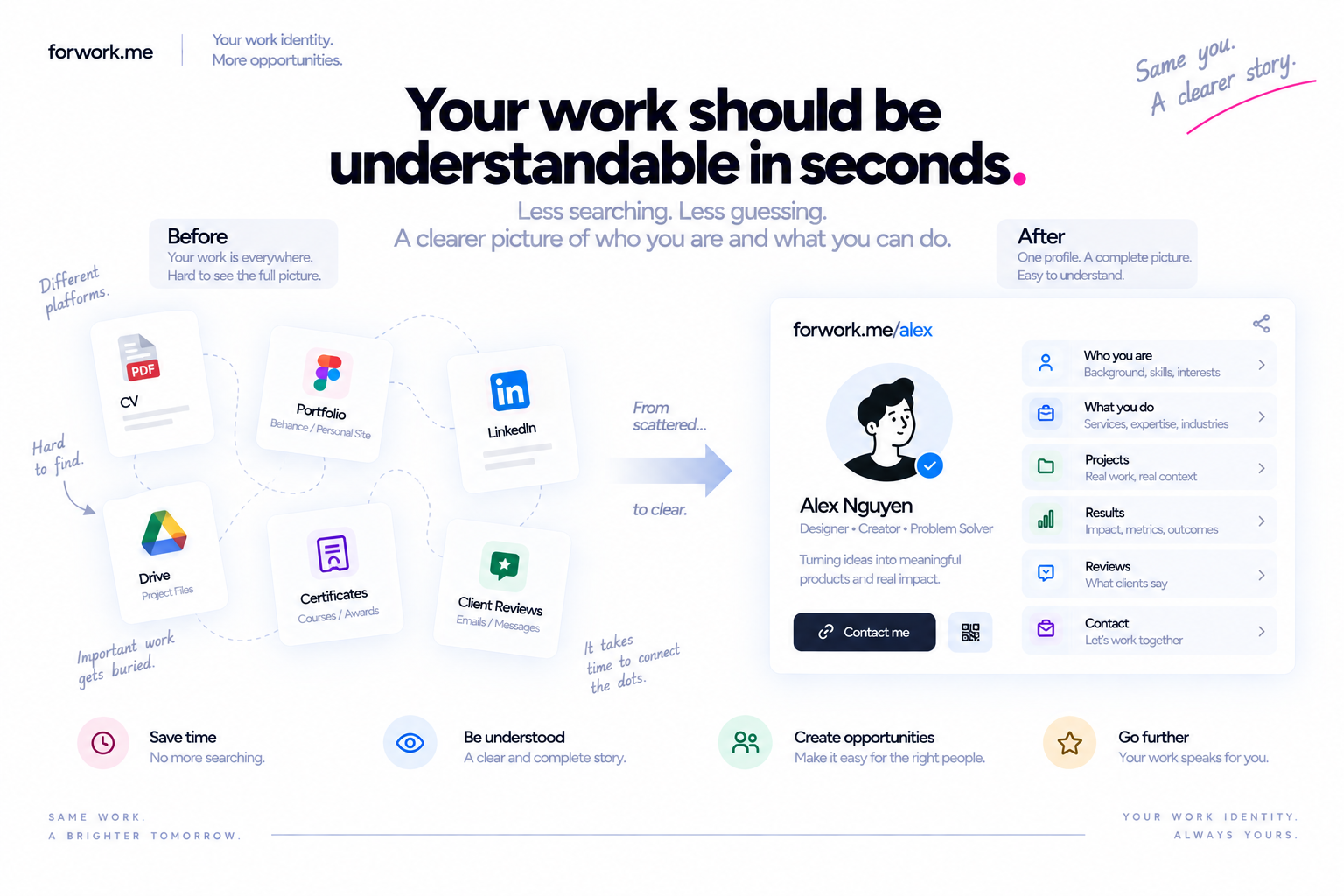
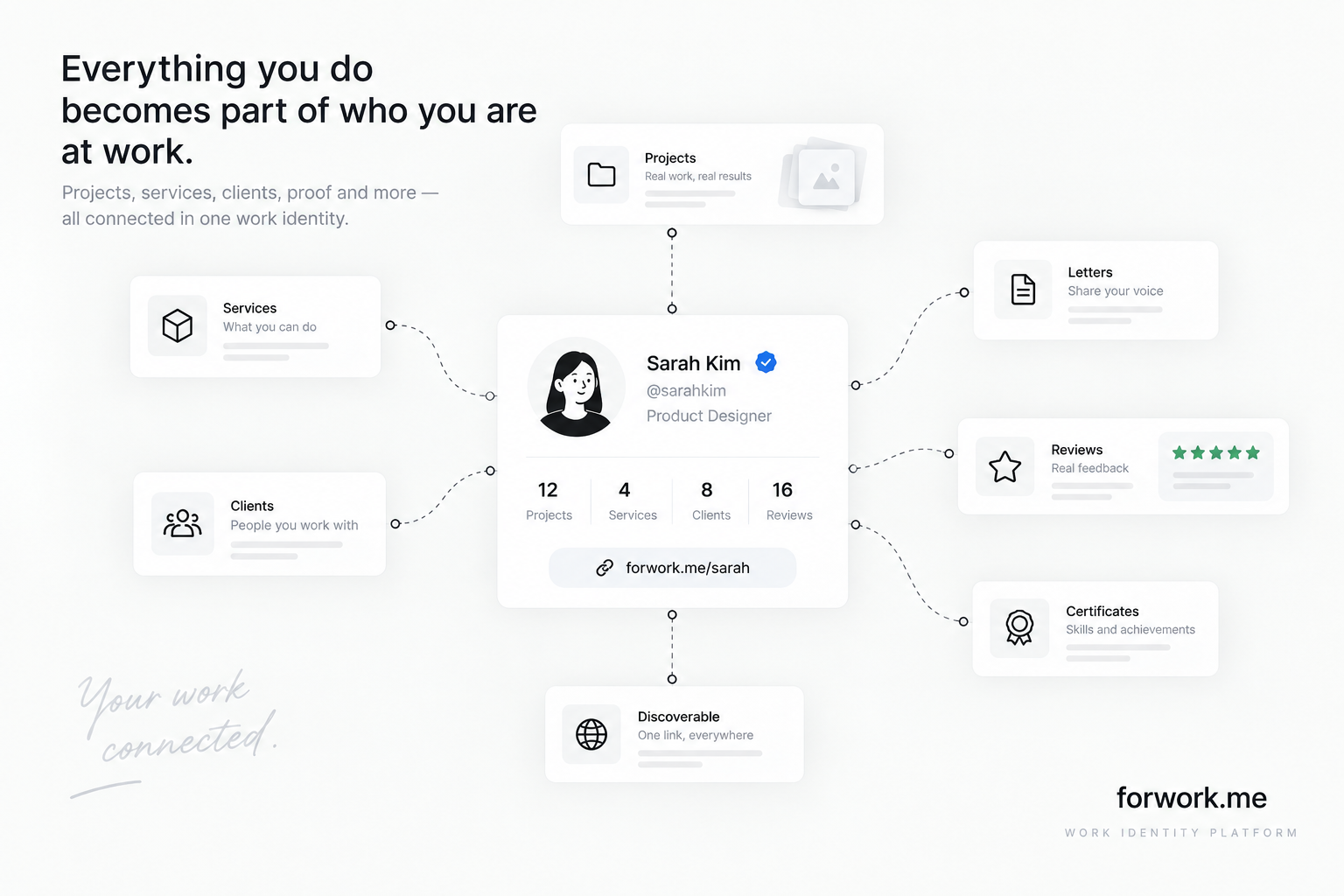
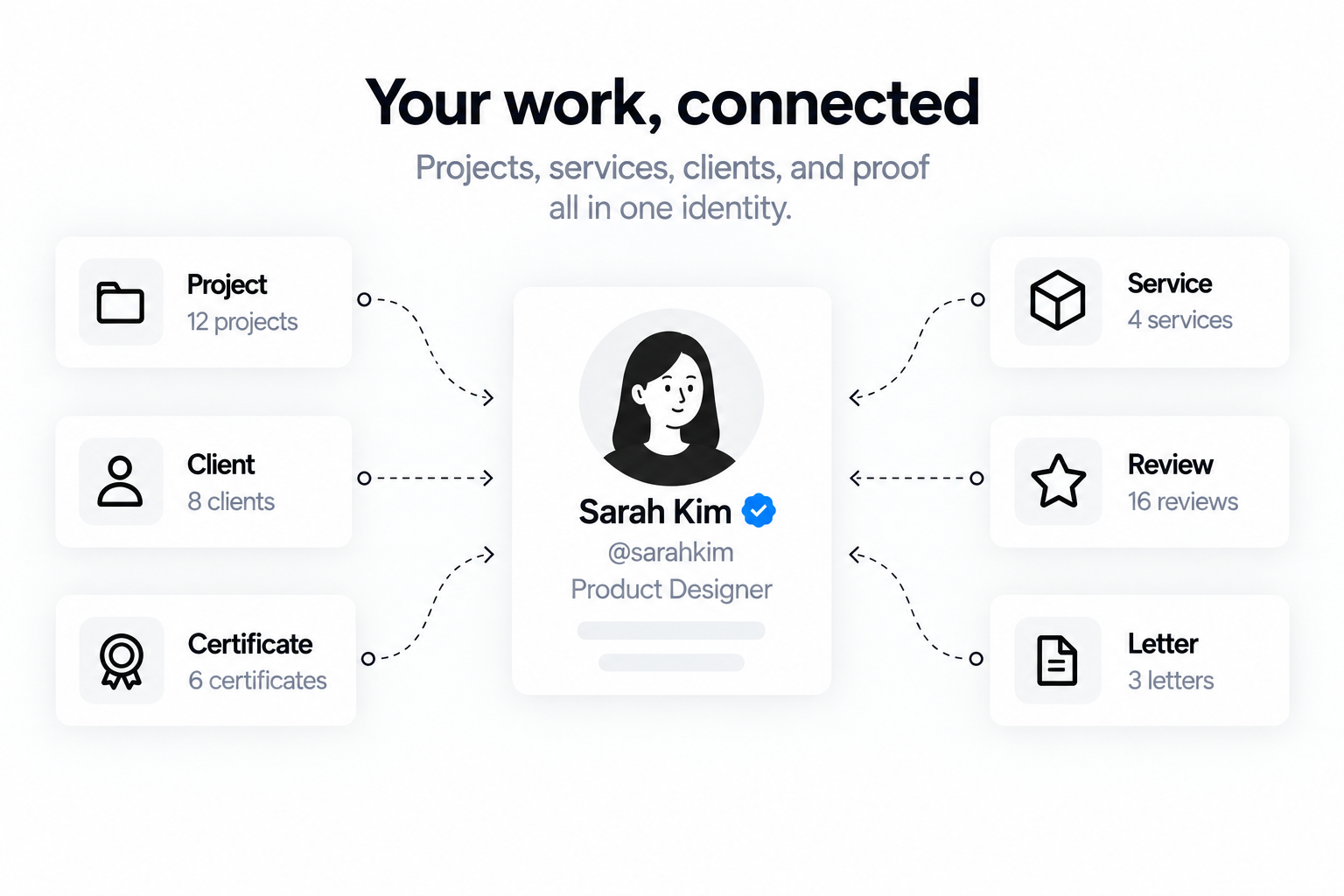
Viewers do not have to piece together your CV, portfolio, projects, and links. You get one place to present everything with context.
Read the Forwork storyEvery detail has a clearer reason and place.
Projects and outcomes sit next to your profile.
One compact link is ready for a CV, email, or message.
Summarize your role, skills, key links, and the strengths you want people to remember.
Each project can carry context, role, outcomes, and links so viewers can verify quickly.
Forwork helps your CV, portfolio, and links tell one consistent story.
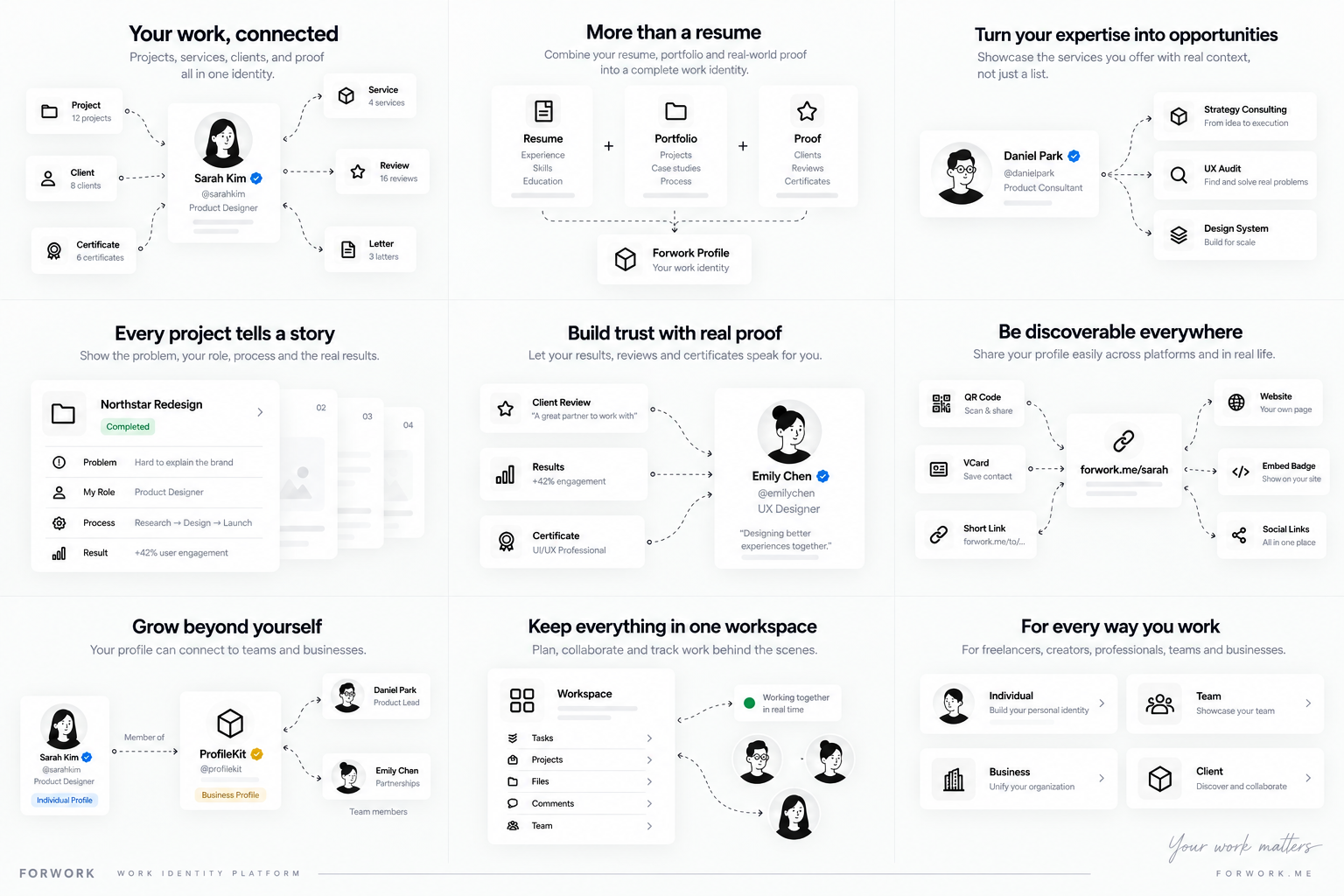
A page for your role, skills, experience, and important public information.
IntroduceA space to tell project stories with context, role, visuals, results, and links.
Show proofBring your CV, portfolio, and related links into one shareable place.
Bring togetherCustomize your path, domain, and how your profile appears when shared.
ShareEvents turn activity into a lasting company timeline. Open Letters preserve the ideas, messages and leadership voice behind that work.
Forwork Events helps companies announce upcoming events, support live activities, and preserve past events as part of their Business Identity.
Forwork Letters helps companies, founders and leaders preserve beliefs, hopes, perspectives and messages they want remembered as part of Business Identity.
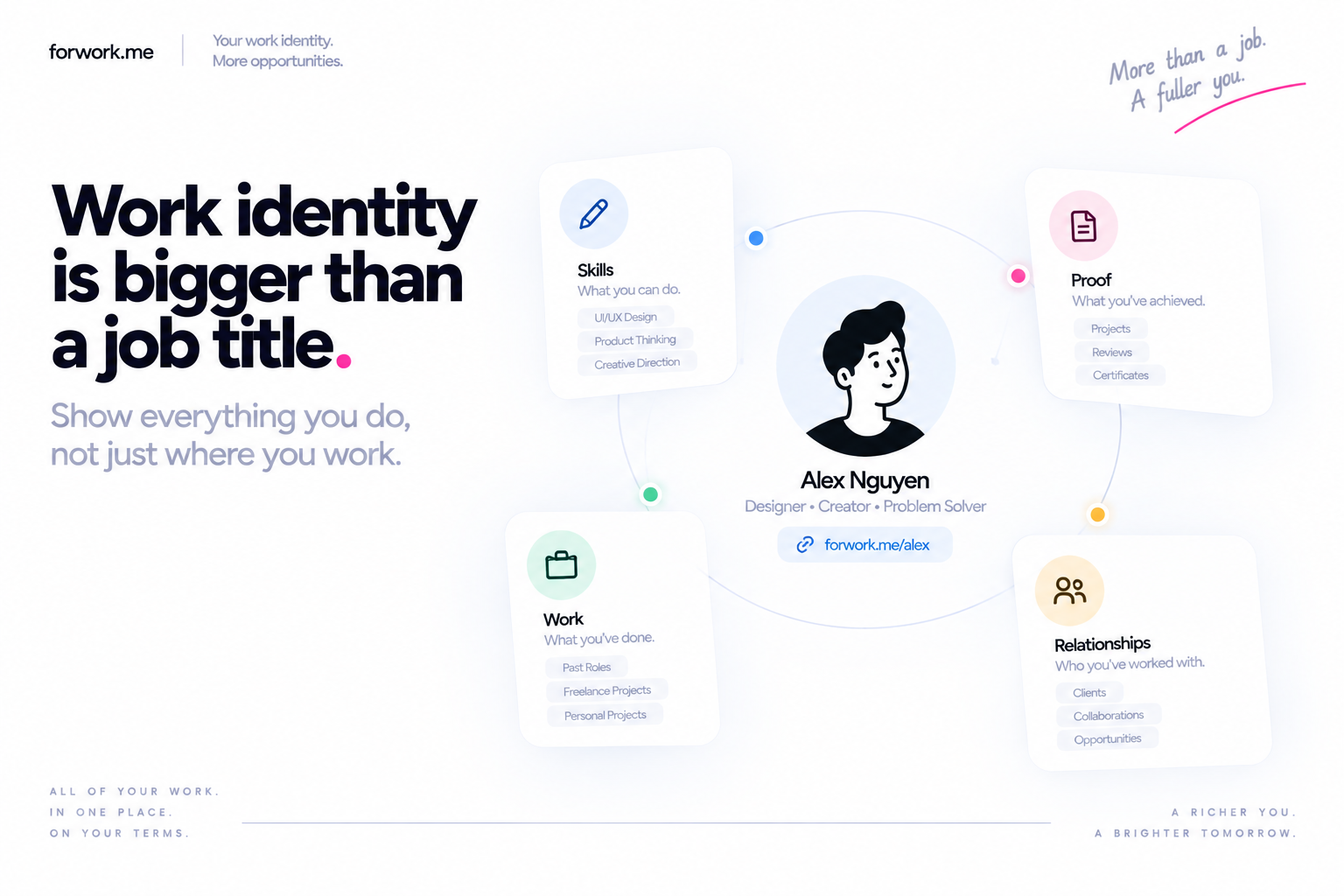
Viewers need to see who you are, what you have done, how you can help, how you think, and how to contact you. Forwork turns those layers into one readable flow.
Role, skills, experience, and the main points that help viewers place you quickly.
Projects carry context, role, results, and links so proof stays connected to the story.
Services, scope, collaboration style, and fit are clear before someone reaches out.
Short notes, experience, and viewpoints help readers understand how you approach problems.
FAQs answer process, collaboration, boundaries, and what to know before starting.
Describe client type, problem, role, and outcome without exposing private data or real client names on the landing page.
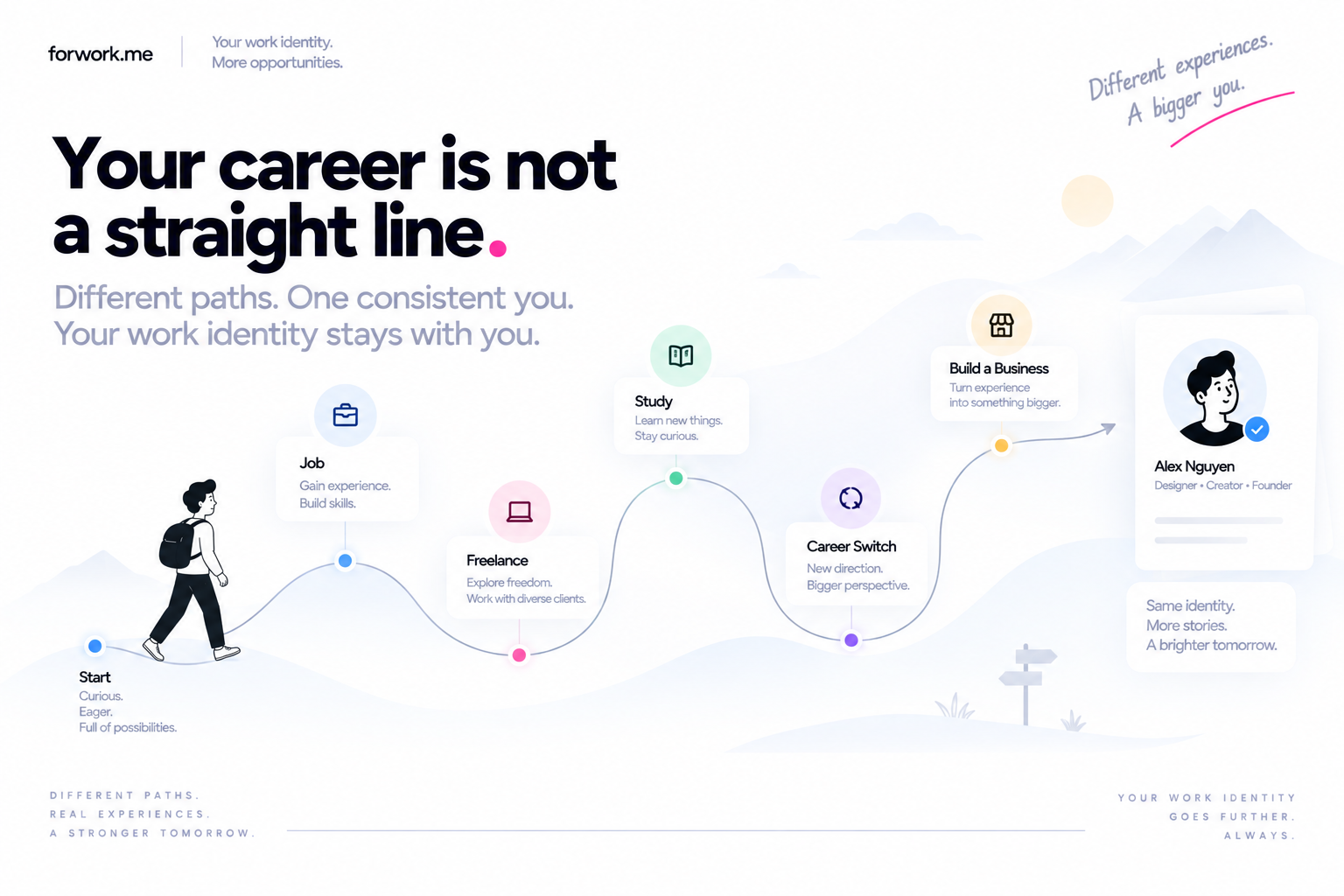
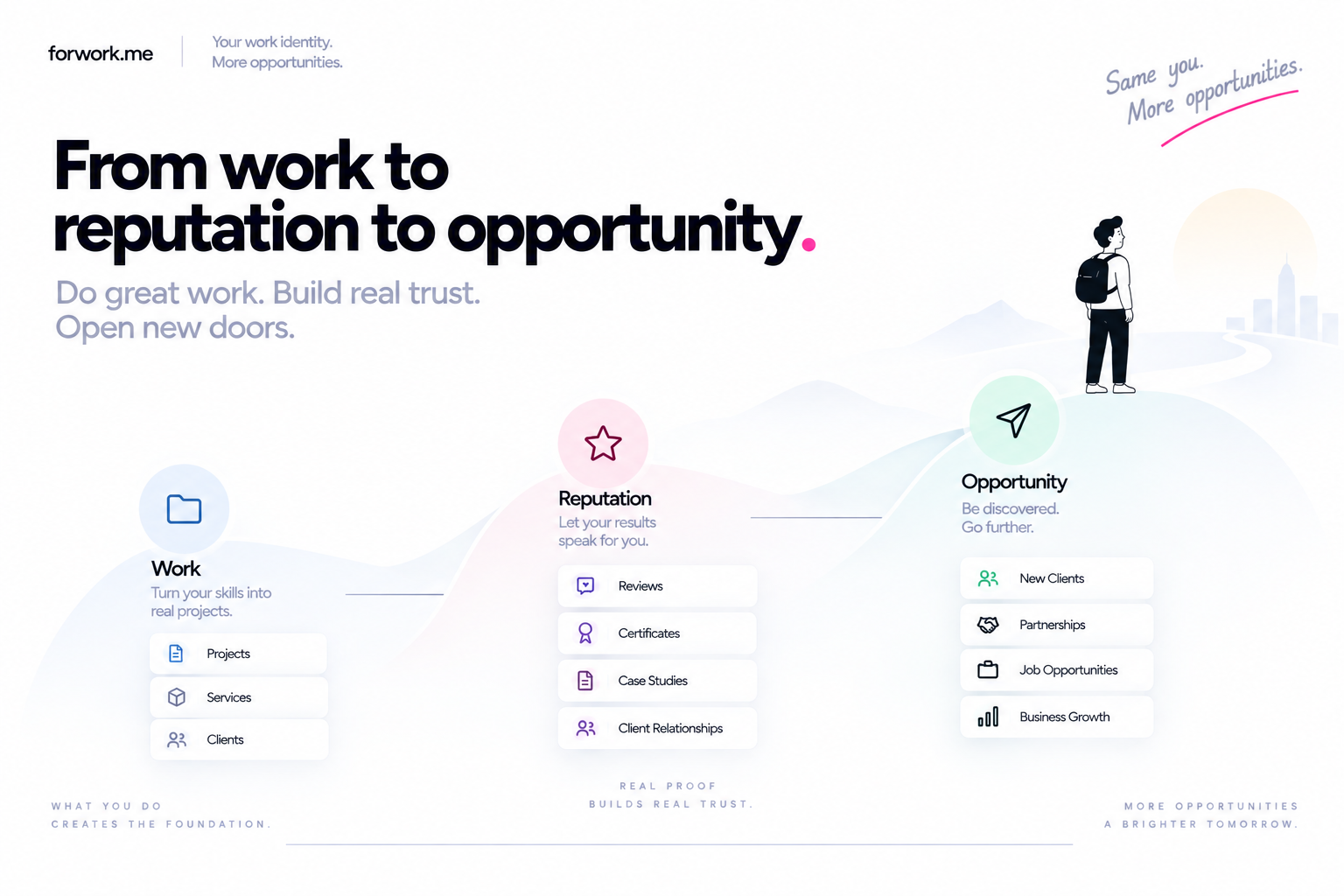
Read the stories about identity, work, value and the human principles shaping Forwork.
Explore all storiesThe opening chapter establishes Forwork’s first ethical choice: systems of work must serve people, not turn people into material for optimisation.
An opening chapter on marketing’s deeper origin: not the history of speaking louder, but the history of helping value travel from the people who create it to the people who may need, understand and trust it.
The first day at a new job begins not only with work, but with hope, unease and the question of whether we are good enough to belong. Chapter 1 opens the inner life of a working person.
A foundational definition of Forwork: not an online CV, portfolio, or social profile, but a Work Identity system that turns work into evidence, evidence into meaning, meaning into identity, and identity into opportunity.
How Forwork connects thinking, identity, opportunity, work, proof, and growth into a Work Identity loop that compounds over time.
How to start using Forwork in the first 30 minutes by selecting the right signals, projects, and proof instead of completing every field.
How students can use Forwork to turn coursework, clubs, internships, side projects, and learning into the first proof of a Work Identity.
A foundation for understanding data on Forwork: ownership, control, permission, visibility, and trust before discussing AI, indexing, or third-party crawlers.
How to distinguish professional identity from biography and turn personal history into a system of signals that helps others understand who you are at work.
Why doing strong work is not enough for others to understand the value you created, and how to turn work into visible contribution, evidence, and impact.
Why deep expertise can still be hard to understand, and how to turn knowledge into something other people can grasp, remember, and use.
Why process is part of the value a client buys: not only the final result, but also clear expectations, visible progress, reliable communication, and reduced uncertainty.
Why silence during execution creates uncertainty, invites assumptions, and weakens confidence even when the work itself is progressing.
Why a project should not end at file delivery: outputs need context, adoption, outcomes, and proof before the work can become durable value.
How to treat a proposal as decision architecture: clarify the decision, identify uncertainty, introduce evidence, build confidence, and make the ask explicit.
Why trust cannot be declared directly, and how credibility emerges from observable, inspectable, and repeated signals over time.
Why a business needs clear beliefs to turn perspective into principles, principles into behavior, behavior into decisions, and repeated decisions into culture.
Why many Projects do not automatically form a Body of Work, and how work must be selected, connected, and interpreted into a meaningful pattern.
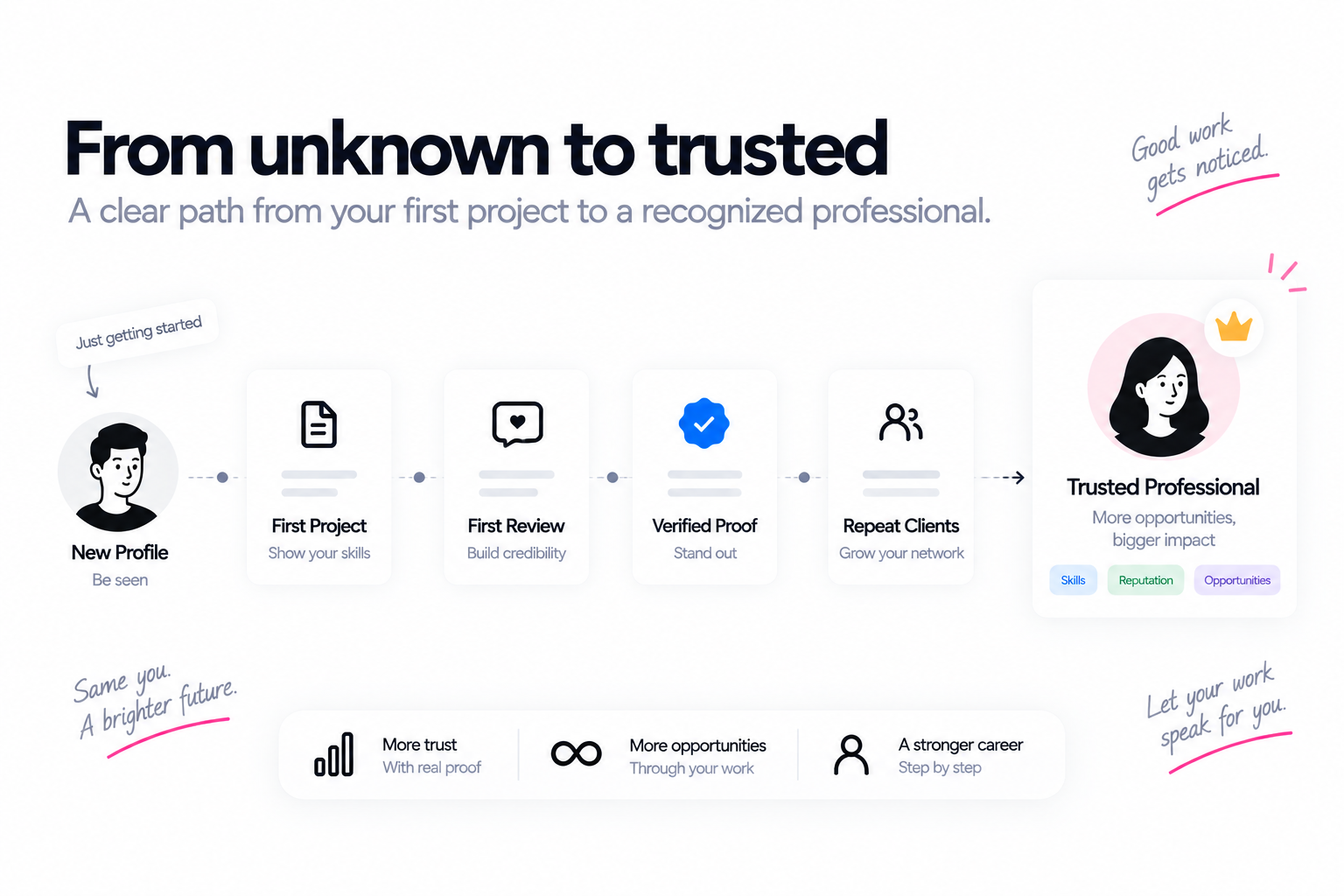
Why doing good work is not enough to create opportunity, and how Work must move through Proof, Trust, and Discovery first.
Why legacy is not a final chapter, but something built gradually through trace, adoption, continuity, and lasting influence.
Comparison begins as a tool for orientation. The problem starts when it becomes the only mirror.
The product is not the starting point. Human difficulty is.
What changes because you were there?
When someone opens a Forwork profile, they should not have to piece together a CV, portfolio, social links, and scattered projects. They move from curiosity to clarity faster because each piece has context.
Profile and role give viewers a first anchor.
Projects, tips, and context show how you create value.
Services and FAQs help viewers qualify their need before asking more.
Contact channels sit beside context, so the conversation starts clearer.
Add one link so recruiters can see your projects, role, and outcomes.
Show clients how you have created results before.
Use one public link on social profiles and email signatures.
Bring profile, CV, projects, and related links together.
Tell the context, role, and result behind each project.
Create a stable destination for your work story.
Choose your Forwork link.
Add your role, experience, projects, and public contact channels.
Publish your public profile.
Share the link in your CV, social profile, proposal, or email.
Create the profile first, add projects next, then upgrade when you need more tools.